Loading...
Searching...
No Matches
forcefields::PotentialBase Class Reference
Functions and tools commonly used by potentials. More...
#include <potential_base.hpp>
Inheritance diagram for forcefields::PotentialBase:
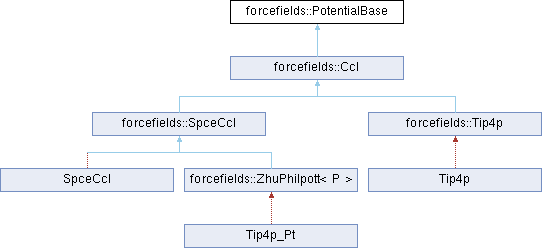
Classes | |
| struct | ChargeGroup |
| struct | Vector3 |
Public Member Functions | |
| PotentialBase () | |
| Non bond interaction cutoff. | |
| PotentialBase (double cutoff, double switchingWidth) | |
| virtual | ~PotentialBase () |
| double | getCutoff () const |
| void | setCutoff (double cutoff) |
Protected Member Functions | |
Angle | |
| void | restrainAngle (double const r1[], double const r2[], double const r3[], double f1[], double f2[], double f3[], double &u, const double k, const double aeq) |
| Angular quadratic restraints. | |
Static Protected Member Functions | |
| static void | divide (double v[], double const divisor) |
| Divide vector. | |
| static double * | crossProduct (const double v[], const double w[], double e[]) |
| Cross product. | |
| static double | dotProduct (double const v[], double const w[]) |
| Dot product. | |
| static void | multiply (double v[], double const factor) |
| Multiply vector. | |
| static double | norm (double const v[]) |
| Norm of 3D vector. | |
| static void | normalise (double v[]) |
| Normalise 3D vector \( \frac{\mathbf v}{ |\mathbf v|} \). | |
Protected Attributes | |
| double | cutoff_ |
| double | periods_ [3] |
| double | switchingWidth_ |
Coulomb | |
| static const double | ONE_OVER_4_PI_EPSILON0 |
| void | calculateCentre (double const r1[], double const r2[], double rc[]) |
| Calculate centre of two points. | |
| void | calculateCentre (double const r1[], double const r2[], double const r3[], double rc[]) |
| Calculate centre of three points. | |
| void | calculateWeightedCentre (double const w1, double const w2, double const w3, double const r1[], double const r2[], double const r3[], double rc[]) |
| Calculate barycentre. | |
| void | coulombWithCutoff (const double r1[], const double r2[], double f1[], double f2[], double &u, double const qq) |
| Coulomb interaction with single charge based cutoff. | |
| void | coulomb (const double r1[], const double r2[], double f1[], double f2[], double &u, double const qq) |
| Compute Coulomb interaction between two charges. | |
| void | coulomb (double distance, double &force, double &energy, double const qq) |
| Compute Coulomb interaction between two charges. | |
| void | spreadForce (double f1[], double f2[], double const fc[]) |
| Spread force on centre to other points. | |
| void | spreadForce (double f1[], double f2[], double f3[], double const fc[]) |
| Spread force on centre to other points. | |
| void | spreadWeightedForce (double const w1, double const w2, double const w3, double f1[], double f2[], double f3[], double const fc[]) |
| Spread force on barycentre to atoms. | |
| template<int N, class R, class F> | |
| void | addForces (ChargeGroup< N, R, F > const &g1, ChargeGroup< N, R, F > &g2) |
| Increment forces. | |
| template<int N, class R, class F> | |
| void | switching (ChargeGroup< N, R, F > &g1, ChargeGroup< N, R, F > &g2, double &energy, double cutoff, double switchingWidth) |
| static const double | EPSILON_PT = 0.68165797577788501 |
| Platinum Lennard-Jones. | |
| static const double | SIGMA_PT = 2.54 |
| double | getSwitchingWidth () const |
| Width of the switching zone. | |
| void | setSwitchingWidth (double width) |
| static double | applyPeriodicity0 (double r, double const period) |
| Minimum image representation. | |
| static void | applyPeriodicity0 (double r[], double const periods[]) |
| Minimum image representation. | |
| void | computePt (int const nAtoms, double positions[], double forces[], double &energy, double const periods[], bool const fixed[]) |
| Potential for Platinum. | |
Bond Interactions | |
| static double | isoscelesBase (double length, double angle) |
| Calculate the base of an isosceles triangle. | |
| void | restrainLength (const double R1[], const double R2[], double F1[], double F2[], double &u, const double k, const double r0) |
| Compute quadratic restraints between two atoms. | |
Lennard-Jones | |
| static double | epsilon (double const A, double const B) |
| Conversion for Lennard-Jones. | |
| static double | sigma (double const A, double const B) |
| Conversion for Lennard-Jones. | |
| static double | smithKongEpsilon (double sigma1, double epsilon1, double sigma2, double epsilon2) |
| Smith and Kong combination rules. | |
| static double | smithKongSigma (double sigma1, double epsilon1, double sigma2, double epsilon2) |
| Smith and Kong combination rules. | |
| void | lennardJones (double const distance, double &force, double &energy, double const epsilon, double const sigma) |
| Lennard-Jones 12-6 between two atoms. | |
| void | lennardJones (const double R1[], const double R2[], double F1[], double F2[], double &E, double const epsilon, double const sigma) |
| Lennard-Jones 12-6 between two atoms. | |
| void | lennardJonesWithCutoff (double const r1[], double const r2[], double f1[], double f2[], double &energy, double const epsilon, double const sigma) |
| Lennard Jones 12-6 Potential with cutoff. | |
| void | switching (double const distance, double &force, double &energy) |
| Smooth cutoff switch off. | |
| void | switching (double const r1[], double const r2[], double f1[], double f2[], double &energy) |
| Smooth cutoff switch off. | |
Periodic Boundaries, Distance... | |
3-D vector. | |
| static double | unBreak0 (double const r, double const ref, double const period) |
| Undo the separation of two atoms created by the periodic boundaries. | |
| static void | unBreak0 (double r[], double const ref[], double const periods[]) |
| Undo the separation of two atoms created by the periodic boundaries. | |
| double | applyPeriodicity1 (double r, int const axis) |
| Minimum image representation. | |
| void | applyPeriodicity1 (double r[]) |
| Minimum image representation. | |
| void | distance (const double x[], const double y[], double z[], double &z1, double &z2) |
| Distance vector, norm and norm square. | |
| void | distance (const double x[], const double y[], double z[], double &z1) |
| Distance. | |
| void | distance (const double x[], const double y[], double z[]) |
| Distance vector, norm. | |
| void | distance (const double x[], const double y[], double &z1) |
| Distance. | |
| void | distance (const double x[], const double y[], Vector3 &z) |
| Distance vector, norm and norm square. | |
| void | setPeriodicity (const double periods[]) |
| Set periodicity. | |
| double | unBreak1 (double const r, double const ref, int const axis) |
| Undo the separation of two atoms created by the periodic boundaries. | |
| void | unBreak1 (double r[], double const ref[]) |
| Undo the separation of two atoms created by the periodic boundaries. | |
Detailed Description
Functions and tools commonly used by potentials.
Contains functions for quadratic retrainst, Lennard-Jones, Coulomb, to manage the periodic boundaries and interface for cutoff. The system of units used is (eV, Angstrom, fs, e). Rules to combine different Lennard-Jones parameters were taken from:
Unlike Lennard-Jones Parameters for Vapor-Liquid Equilibria, Thorsten Schnabel, Jadran Vrabec , Hans Hasse, Institut fur Technische Thermodynamik und Thermische Verfahrenstechnik, Universitat Stuttgart, D-70550 Stuttgart, Germany, http://www.itt.uni-stuttgart.de/~schnabel/CR.pdf.
Definition at line 24 of file potential_base.hpp.
Constructor & Destructor Documentation
◆ PotentialBase() [1/2]
| forcefields::PotentialBase::PotentialBase | ( | ) |
Non bond interaction cutoff.
When the distance between two molecules is over getCutoff(), van der Waals and Coulomb interactions between the two molecules are ignored.
- See also
- getSwitchingWidth().
Definition at line 40 of file potential_base.cpp.
41 : cutoff_(6.5),
42 switchingWidth_(2.0) {
43 periods_[0] = 0.0;
44 periods_[1] = 0.0;
45 periods_[2] = 0.0;
46}
◆ PotentialBase() [2/2]
| forcefields::PotentialBase::PotentialBase | ( | double | cutoff, |
| double | switchingWidth ) |
Definition at line 48 of file potential_base.cpp.
49 : cutoff_(cutoff),
50 switchingWidth_(switchingWidth) {
52 std::cerr << "Error: getSwitchingWidth() > getCutoff()" << std::endl;
53 std::exit(EXIT_FAILURE);
54 };
55 periods_[0] = 0.0;
56 periods_[1] = 0.0;
57 periods_[2] = 0.0;
58}
◆ ~PotentialBase()
|
inlinevirtual |
Definition at line 28 of file potential_base.hpp.
28{};
Member Function Documentation
◆ addForces()
template<int N, class R, class F>
|
protected |
Increment forces.
Increment forces in g2 by forces in g1.
Definition at line 157 of file potential_base.hpp.
158 {
159 increment(g2.force_, g1.force_);
160}
◆ applyPeriodicity0() [1/2]
|
static |
Minimum image representation.
- Returns
- Minimum image representation of r. The value returned is \(\frac{-period}{2} \le r \le \frac{period}{2} \)
- Parameters
-
[in] r Cyclic coordinate. [in] period Period of the coordinates.
Definition at line 85 of file potential_base.cpp.
85 {
86 if (not std::isinf(period)) {
87 double n = r / period + 0.5;
88 // This is slightly more efficient than using function floor().
89 int m = static_cast<int>(n);
90 if (n < 0)
91 --m;
92 r -= m * period;
93 };
94 return r;
95}
◆ applyPeriodicity0() [2/2]
|
static |
Minimum image representation.
- Returns
- Minimum image representation of r. The value returned is \(\frac{-period}{2} \le r \le \frac{period}{2} \).
- Parameters
-
[in] r Three-dimension vector. [in] periods Three-dimension vector containing periods along each of the axes.
Definition at line 104 of file potential_base.cpp.
104 {
105 for (int i = 0; i < 3; ++i)
106 r[i] = applyPeriodicity0(r[i], periods[i]);
107}
static double applyPeriodicity0(double r, double const period)
Minimum image representation.
Definition potential_base.cpp:85
◆ applyPeriodicity1() [1/2]
|
protected |
Minimum image representation.
- Returns
- Minimum image representation of r. The value returned is \(\frac{-period}{2} \le r \le \frac{period}{2} \). The periods should be set with setPeriodicity();
- Parameters
-
[in] r Cyclic coordinate. [in] axis Either 0, 1 or 2.
- See also
- setPeriodicity().
Definition at line 545 of file potential_base.cpp.
◆ applyPeriodicity1() [2/2]
|
protected |
Minimum image representation.
- Returns
- Minimum image representation of r. The value returned is \(\frac{-period}{2} \le r \le \frac{period}{2} \). The periods should be set with setPeriodicity();
- Parameters
-
[in] r Three-dimension vector.
- See also
- setPeriodicity().
Definition at line 534 of file potential_base.cpp.
◆ calculateCentre() [1/2]
|
protected |
Calculate centre of three points.
- See also
- calculateCentre().
Definition at line 196 of file potential_base.cpp.
197 {
198 for (int i = 0; i < 3; ++i) {
199 rc[i] =
201 };
202}
double unBreak1(double const r, double const ref, int const axis)
Undo the separation of two atoms created by the periodic boundaries.
Definition potential_base.cpp:641
◆ calculateCentre() [2/2]
|
protected |
Calculate centre of two points.
Calculate the centre of r1 and r2 and store the result in rc.
- Note
- The centre is calculated for the image or r2 the closed to r1.
Definition at line 188 of file potential_base.cpp.
189 {
190 for (int i = 0; i < 3; ++i) {
191 rc[i] = (r1[i] + unBreak1(r2[i], r1[i], i)) * 0.5;
192 };
193}
◆ calculateWeightedCentre()
|
protected |
Calculate barycentre.
The inverse of this functions the forces is spreadWeightedForce()
- Precondition
- Sum of weigths w1, w2, w3 must be 1.
Definition at line 208 of file potential_base.cpp.
◆ computePt()
|
protected |
Potential for Platinum.
Simple 12-6 Lennard-Jones potential for Platinum.
Parameters from: C. Kittel, Introduction to Solid State Physics, (Wiley, New York, 1986).
- Parameters
-
[in] nAtoms Number of atoms. [in] positions Positions of atoms. [out] forces Forces on atoms. [out] energy Potential energy. [in] periods Periods for periodic boundary conditions. [in] fixed Array of boolean of length equal to nAtoms. The array shall contain true is the atom is fixed, false is movable.
Definition at line 658 of file potential_base.cpp.
660 {
661 int const nCoord = 3 * nAtoms;
662 for (int i = 0; i < nCoord; ++i)
663 forces[i] = 0.0;
664 energy = 0.0;
665 double const(*r)[3] = reinterpret_cast<double const(*)[3]>(positions);
666 double (*f)[3] = reinterpret_cast<double (*)[3]>(forces);
668 // some functions to work.
669 for (int i = nAtoms - 1; i > 0; --i) {
670 for (int j = i - 1; j >= 0; --j) {
671 // A fixed neighbor still exerts a force on a movable atom. Skip only
672 // a pair in which both atoms are fixed.
673 if (not fixed[i] or not fixed[j]) {
675 SIGMA_PT);
676 };
677 };
678 };
679}
void lennardJonesWithCutoff(double const r1[], double const r2[], double f1[], double f2[], double &energy, double const epsilon, double const sigma)
Lennard Jones 12-6 Potential with cutoff.
Definition potential_base.cpp:397
◆ coulomb() [1/2]
|
protected |
Compute Coulomb interaction between two charges.
\( U = \frac{q_1q_2}{|\mathbf r_1- \mathbf r_2|} \)
- Parameters
-
[in] r1 Positions of atom 1. [in] r2 Positions of atom 2. [in,out] f1 Incremented by force on atom 1. [in,out] f2 Incremented by force on atom 2. [in,out] energy Incremented by energy. [in] qq Product of the charges.
- Warning
- f1, f2 and u are incremented.
Definition at line 256 of file potential_base.cpp.
257 {
258 double d1, d[3], f, en;
259 // d: vector distance (r1-r2), d1 distance and d2 squared distance
260 distance(r1, r2, d, d1);
261 coulomb(d1, f, en, qq);
262 for (int l = 0; l < 3; ++l) {
263 f1[l] += f * d[l] / d1;
264 f2[l] -= f * d[l] / d1;
265 };
266 energy += en;
267}
void distance(const double x[], const double y[], double z[], double &z1, double &z2)
Distance vector, norm and norm square.
Definition potential_base.cpp:555
void coulomb(const double r1[], const double r2[], double f1[], double f2[], double &u, double const qq)
Compute Coulomb interaction between two charges.
Definition potential_base.cpp:256
◆ coulomb() [2/2]
|
protected |
Compute Coulomb interaction between two charges.
\( U = \frac{q_1q_2}{|\mathbf r_1- \mathbf r_2|} \)
- Parameters
-
[in] distance between two charges [out] force Force Resulting from the coulom interaction. [out] energy Potential energy. [in] qq Product of the charges.
Definition at line 275 of file potential_base.cpp.
276 {
278 force = energy / distance;
279}
static const double ONE_OVER_4_PI_EPSILON0
Definition potential_base.hpp:54
◆ coulombWithCutoff()
|
protected |
Coulomb interaction with single charge based cutoff.
\( U = \frac{q_1q_2}{|\mathbf r_1- \mathbf r_2|} \)
- Parameters
-
[in] r1 Positions of atom 1. [in] r2 Positions of atom 2. [in,out] f1 Incremented by force on atom 1. [in,out] f2 Incremented by force on atom 2. [in,out] energy Incremented by energy. [in] qq Product of the charges.
- Warning
- f1, f2 and u are incremented.
- See also
- getCutoff() and getSwitchingWidth().
Definition at line 229 of file potential_base.cpp.
231 {
232 double d1, d[3];
233 // d: vector distance (r1-r2), d1 distance and d2 squared distance
234 distance(r1, r2, d, d1);
236 double f, en;
237 coulomb(d1, f, en, qq);
238 switching(d1, f, en);
239 for (int l = 0; l < 3; ++l) {
240 f1[l] += f * d[l] / d1;
241 f2[l] -= f * d[l] / d1;
242 };
243 energy += en;
244 }
245}
void switching(ChargeGroup< N, R, F > &g1, ChargeGroup< N, R, F > &g2, double &energy, double cutoff, double switchingWidth)
Definition potential_base.hpp:163
◆ distance() [1/5]
|
protected |
◆ distance() [2/5]
|
protected |
Distance vector, norm.
- See also
- distance(const double x[], const double y[], double z[], double & z1, double & z2) and setPeriodicity().
Definition at line 581 of file potential_base.cpp.
◆ distance() [3/5]
|
protected |
Distance.
- Parameters
-
[in] x, y Two three dimension vector. [out] z[] [out] z1 \(| \mathbf x -\mathbf y | \) with pbc applied.
- See also
- setPeriodicity().
Definition at line 572 of file potential_base.cpp.
◆ distance() [4/5]
|
protected |
Distance vector, norm and norm square.
- Parameters
-
[in] x, y Two three dimension vector. [out] z \( \mathbf x -\mathbf y \) with pbc applied. [out] z1 \( |\mathbf z | \) [out] z2 \( |\mathbf z |^2 \)
- See also
- setPeriodicity().
Definition at line 555 of file potential_base.cpp.
556 {
557 assert(x);
558 assert(y);
559 assert(z);
560 for (int i = 0; i < 3; ++i)
561 z[i] = x[i] - y[i];
562 applyPeriodicity1(z);
563 z2 = z[0] * z[0] + z[1] * z[1] + z[2] * z[2];
564 z1 = std::sqrt(z2);
565}
double applyPeriodicity1(double r, int const axis)
Minimum image representation.
Definition potential_base.cpp:545
◆ distance() [5/5]
|
protected |
Distance vector, norm and norm square.
- Parameters
-
[in] x, y Two three dimension vector. [out] z Return x-y, |x-y| and |x-y|^2.
- See also
- setPeriodicity().
Definition at line 595 of file potential_base.cpp.
◆ epsilon()
|
staticprotected |
Conversion for Lennard-Jones.
The Lennard-Jones is sometimes expressed as:
\[ \frac{A}{r^{12}}-\frac{B}{r^6} \]
whereas the functions lennardJones() use the expression:
\[ 4\epsilon\left[\left(\frac{\sigma}{r}\right)^{12}-\left(\frac{\sigma}{r}\right)^6\right] \]
The function calculates the parameter epsilon.
Definition at line 333 of file potential_base.cpp.
333 {
334 return B * B / A / 4.0;
335}
◆ getCutoff()
| double forcefields::PotentialBase::getCutoff | ( | ) | const |
Definition at line 60 of file potential_base.cpp.
◆ getSwitchingWidth()
| double forcefields::PotentialBase::getSwitchingWidth | ( | ) | const |
Width of the switching zone.
In the switching zone the potential is replaced by \( V=U\times S(x) \) where U is the real potential V the switching potential and S the switching function. Variable x=0 at the beginning of the switching zone and x=1 at the end the function S is \( S=2x^3-3x^2+1 \) which has the following properties: S(0)=1, S(1)=0, S'(0)=0 and S'(1)=0. The switching when the distance between the two molecules is getCutoff()-getSwitchingWidth() and ends when the distance is getCutoff();
- See also
- getCutoff().
Definition at line 74 of file potential_base.cpp.
◆ isoscelesBase()
|
staticprotected |
Calculate the base of an isosceles triangle.
An isosceles triangle is a triangle with two sides of equal length. If you know the length of the two equal sides and the angle between the two, the function can calculate the length of the third side.
- Parameters
-
[in] length Length of the two equal sides of the triangle. [in] angle Angle between the two equal side in radiant.
Definition at line 116 of file potential_base.cpp.
116 {
117 return 2.0 * length * std::sin(angle / 2.0);
118}
◆ lennardJones() [1/2]
|
protected |
Lennard-Jones 12-6 between two atoms.
- Parameters
-
[in] R1, R2 Positions of atom 1 and 2. [in,out] F1, F2 Force on atom 1 and 2. [in,out] E Energy. [in] epsilon, sigma Parameters of the Lennard-Jones potential.
- Warning
- F1, F2 and u are incremented.
- See also
- lennardJones(distance, ...).
Definition at line 363 of file potential_base.cpp.
365 {
366 // WARNING: F1 and F2 are incremented.
367 double F, Fx, en;
368 double R12[3];
369 double L, L2;
370 distance(R2, R1, R12, L, L2);
372 E += en;
373 Fx = F * R12[0] / L;
374 F1[0] -= Fx;
375 F2[0] += Fx;
376 Fx = F * R12[1] / L;
377 F1[1] -= Fx;
378 F2[1] += Fx;
379 Fx = F * R12[2] / L;
380 F1[2] -= Fx;
381 F2[2] += Fx;
382}
static double epsilon(double const A, double const B)
Conversion for Lennard-Jones.
Definition potential_base.cpp:333
void lennardJones(double const distance, double &force, double &energy, double const epsilon, double const sigma)
Lennard-Jones 12-6 between two atoms.
Definition potential_base.cpp:347
static double sigma(double const A, double const B)
Conversion for Lennard-Jones.
Definition potential_base.cpp:423
◆ lennardJones() [2/2]
|
protected |
Lennard-Jones 12-6 between two atoms.
Return the energy and scalar force resulting from a Lennard-Jones potential. \( E=4*\epsilon*(x^{12}-x^6) \) with \( x=\frac{\sigma}{r} \) and \(F=-\frac{dE}{dr} \) .
- Parameters
-
[in] distance Distance between two atoms. [out] force Force. [out] energy Potential energy. [in] epsilon, sigma Lennard-Jones parameters.
Definition at line 347 of file potential_base.cpp.
◆ lennardJonesWithCutoff()
|
protected |
Lennard Jones 12-6 Potential with cutoff.
Interaction between two atoms. Cutoff and switching width should be set with setCutoff() and setSwitchingWidth().
- Parameters
-
[in] r1, r2 Positions of the two atoms. [in,out] f1, f2 Forces on the two atoms. [in,out] energy Potential energy. [in] epsilon, sigma See lennardJones() for definition of sigma and esplion.
- See also
- lennardJones().
Definition at line 397 of file potential_base.cpp.
◆ restrainAngle()
|
protected |
Angular quadratic restraints.
\( U=k(a-a_0)^2 \)
- Parameters
-
[in] r1[], r2[], r3[] Positions of atoms. [in,out] f1[], f2[], f3[] Force on atoms. The forces are incremeneted by the function. [in,out] u Incremented by energy. [in] k Potential curvature [in] aeq Angle made by the three atoms 1,2,3 at equilibrium.
Definition at line 160 of file potential_base.cpp.
163 {
164 double r12[3], r12_1, r12_2, r23[3], r23_1, r23_2, cosa, a, m, d12, d23;
165 distance(r2, r1, r12, r12_1, r12_2);
166 distance(r3, r2, r23, r23_1, r23_2);
167 cosa = -dotProduct(r12, r23) / r12_1 / r23_1;
168 a = std::acos(cosa);
169 u += k * (a - aeq) * (a - aeq);
170 m = -2 * k * (a - aeq); // moment
171 m /= -1 * std::sqrt(1 - cosa * cosa); //*d(a)/d(cos a)
172 for (int i = 0; i < 3; ++i) {
173 d12 = -cosa * r12[i] / r12_2 - r23[i] / r12_1 / r23_1; // d(cos a)/d(r12)
174 d23 = -cosa * r23[i] / r23_2 - r12[i] / r12_1 / r23_1; // d(cos a)/d(r23)
175 f1[i] -= m * d12;
176 f2[i] += m * (d12 - d23);
177 f3[i] += m * d23;
178 };
179}
static double dotProduct(double const v[], double const w[])
Dot product.
Definition potential_base.hpp:216
◆ restrainLength()
|
protected |
Compute quadratic restraints between two atoms.
\( U=k(r-r_0)^2 \)
- Parameters
-
[in] R1[] Positions of atom 1. [in] R2[] Positions of atom 2. [in,out] F1[] Incremented by force on atom 1. [in,out] F2[] Incremented by force on atom 2. [in,out] u Incremented by energy. [in] k Potential curvature [in] req Distance of the two atoms at equilibrium.
- Warning
- F1, F2 and u are incremented.
Definition at line 130 of file potential_base.cpp.
132 {
133 double f, fx;
134 double r[3], r1, r2;
135 distance(R2, R1, r, r1, r2);
136 double d = r1 - req;
137 f = -2.0 * k * d;
138 u += k * d * d;
139 fx = f * r[0] / r1;
140 F1[0] -= fx;
141 F2[0] += fx;
142 fx = f * r[1] / r1;
143 F1[1] -= fx;
144 F2[1] += fx;
145 fx = f * r[2] / r1;
146 F1[2] -= fx;
147 F2[2] += fx;
148}
◆ setCutoff()
| void forcefields::PotentialBase::setCutoff | ( | double | cutoff | ) |
Definition at line 62 of file potential_base.cpp.
62{ cutoff_ = cutoff; }
◆ setPeriodicity()
|
protected |
Set periodicity.
Must be used before calling certain functions: distance(), applyPeriodicity(), etc...
Definition at line 603 of file potential_base.cpp.
◆ setSwitchingWidth()
| void forcefields::PotentialBase::setSwitchingWidth | ( | double | width | ) |
Definition at line 76 of file potential_base.cpp.
76{ switchingWidth_ = width; }
◆ sigma()
|
staticprotected |
Conversion for Lennard-Jones.
The Lennard-Jones is sometimes expressed as:
\[ \frac{A}{r^{12}}-\frac{B}{r^6} \]
whereas the functions lennardJones() use the expression:
\[ 4\epsilon\left[\left(\frac{\sigma}{r}\right)^{12}-\left(\frac{\sigma}{r}\right)^6\right] \]
The function calculates the parameter sigma.
Definition at line 423 of file potential_base.cpp.
423 {
424 return std::pow(A / B, 1.0 / 6.0);
425}
◆ smithKongEpsilon()
|
staticprotected |
Smith and Kong combination rules.
\[ \epsilon^{SK}_{12}= \frac{2^{13}\epsilon_1\sigma_1^6\epsilon_2\sigma_2^6}{\left[(\epsilon_1\sigma_1^{12})^\frac{1}{13}+(\epsilon_1\sigma_1^{12})^\frac{1}{13}\right]^{13}} \]
- See also
- smithKongSigma()
Definition at line 433 of file potential_base.cpp.
434 {
435 double n, d;
436 double s1_2 = sigma1 * sigma1, sa6 = s1_2 * s1_2 * s1_2;
437 double s2_2 = sigma2 * sigma2, sb6 = s2_2 * s2_2 * s2_2;
438 n = 8192.0 * epsilon1 * sa6 * epsilon2 * sb6; // 2^13 = 8192
439 d = std::pow(epsilon1 * sa6 * sa6, 1.0 / 13.0) +
440 std::pow(epsilon2 * sb6 * sb6, 1.0 / 13.0);
441 d = std::pow(d, 13);
442 return n / d;
443}
◆ smithKongSigma()
|
staticprotected |
Smith and Kong combination rules.
Combination of unlike Lennard-Jones parameters
\[ \sigma^{SK}= \left[ \frac{(\epsilon_1\sigma_1^{12})^{\frac{1}{13}}+(\epsilon_2\sigma_2^{12})^{\frac{1}{13}}} {2^{13}\sqrt{\epsilon_1\sigma_1^6\epsilon_2\sigma_2^6}} \right]^\frac{1}{6} \]
Definition at line 455 of file potential_base.cpp.
456 {
457 double s1_2 = sigma1 * sigma1;
458 double const sa6 = s1_2 * s1_2 * s1_2;
459 double s2_2 = sigma2 * sigma2;
460 double const sb6 = s2_2 * s2_2 * s2_2;
461 double n, d;
462 n = std::pow(epsilon1 * sa6 * sa6, 1.0 / 13.0) +
463 std::pow(epsilon2 * sb6 * sb6, 1.0 / 13.0);
464 n = std::pow(n, 13.0);
465 d = 8192.0 * std::sqrt(epsilon1 * sa6 * epsilon2 * sb6); // 2^13 = 8192
466 return std::pow(n / d, 1.0 / 6.0);
467}
◆ spreadForce() [1/2]
|
protected |
Spread force on centre to other points.
Spread force fc to f1, f2. Each receives a half of the force.
Definition at line 284 of file potential_base.cpp.
284 {
285 for (int i = 0; i < 3; ++i) {
286 double const f = fc[i] / 2;
287 f1[i] += f;
288 f2[i] += f;
289 };
290}
◆ spreadForce() [2/2]
|
protected |
Spread force on centre to other points.
Spread force fc to f1, f2, f3. Each receives 1/3 of the force.
Definition at line 295 of file potential_base.cpp.
296 {
297 for (int i = 0; i < 3; ++i) {
298 double const f = fc[i] / 3;
299 f1[i] += f;
300 f2[i] += f;
301 f3[i] += f;
302 };
303}
◆ spreadWeightedForce()
|
protected |
Spread force on barycentre to atoms.
This is the inverse functions calculateWeightedCentre()
- Precondition
- Sum of weigths w1, w2, w3 must be 1.
- Parameters
-
[in] w1, w2, w3 weights. [in,out] f1, f2, f3 vector to spread fc to. [in,out] fc force to spread.
Definition at line 312 of file potential_base.cpp.
315 {
316 for (int i = 0; i < 3; ++i) {
317 double const f = fc[i];
318 f1[i] += f * w1;
319 f2[i] += f * w2;
320 f3[i] += f * w3;
321 };
322}
◆ switching() [1/3]
template<int N, class R, class F>
|
protected |
Definition at line 163 of file potential_base.hpp.
166 {
167 double z[3], z1;
168 distance(g1.centre_, g2.centre_, z, z1);
169 assert(z1 <= cutoff);
170 assert(z1 >= cutoff - switchingWidth);
171 double x = (z1 - cutoff + switchingWidth) / switchingWidth;
172 double S = (2 * x - 3) * x * x + 1;
173 double dS = 6 * x * (x - 1);
174 double const u = energy;
175 for (int i = 0; i < N; ++i) {
176 for (int k = 0; k < 3; ++k) {
177 g1.force_[i][k] =
178 g1.force_[i][k] * S - u * dS / switchingWidth * z[k] / z1 / N;
179 g2.force_[i][k] =
180 g2.force_[i][k] * S + u * dS / switchingWidth * z[k] / z1 / N;
181 }
182 };
183 energy *= S;
184}
◆ switching() [2/3]
|
protected |
Smooth cutoff switch off.
Should be called when the distance between the two atoms is in the switching zone (see getSwitchinWidth() for more explanation).
- Parameters
-
[in] distance Distance between two atoms. [in,out] force On atoms. The input values should be the full force for the interaction between the two atoms. The function returns the corrected force. [in,out] energy Potential energy. The input should be the full energy for the interaction between the two atoms. The functions returns the corrected energy.
- Note
- The function is for atom based cutoff only.
- See also
- getSwitchinWidth().
Definition at line 481 of file potential_base.cpp.
482 {
484 if (x >= 1.0) { // if more: cutoff
485 force = 0.0;
486 energy = 0.0;
487 }
488 if (x > 0.0) { // if more: switching zone
489 double S = (2 * x - 3) * x * x + 1;
490 double dS = 6 * x * (x - 1);
491 double const u = energy;
492 force = force * S - u * dS / switchingWidth_;
493 energy *= S;
494 };
495 // else: full interaction, leave force and energy as the are.
496}
◆ switching() [3/3]
|
protected |
Smooth cutoff switch off.
Should be called when the distance between the two atoms is in the switching zone (see getSwitchinWidth() for more explanation).
- Parameters
-
[in] r1, r2 Positions of atoms. [in,out] f1, f2 Forces on atoms. The input values should be the full forces for the interaction between the two atoms. The function returns the corrected forces. [in,out] energy Potential energy. The input should be the full energy for the interaction between the two atoms. The functions returns the corrected energy.
- Note
- The function is for atom based cutoff only.
- See also
- getSwitchinWidth().
Definition at line 511 of file potential_base.cpp.
512 {
513 double z[3], z1;
514 distance(r1, r2, z, z1);
516 assert(x > 0.0);
517 assert(x < 1.0);
518 double S = (2 * x - 3) * x * x + 1;
519 double dS = 6 * x * (x - 1);
520 double const u = energy;
521 for (int k = 0; k < 3; ++k) {
522 f1[k] = f1[k] * S - u * dS / switchingWidth_ * z[k] / z1;
523 f2[k] = f2[k] * S + u * dS / switchingWidth_ * z[k] / z1;
524 };
525 energy *= S;
526}
◆ unBreak0() [1/2]
|
staticprotected |
Undo the separation of two atoms created by the periodic boundaries.
Example: two atoms H and O are at respectively x = -9.5 and x = 9.5 and the period along x is 20. The real distance between the two atoms is 1. We use unBreak() on the coordinates of these two atoms:
unBreak(rh, ro);
The coordinates rh of H is now 10.5 thus making O and H appears at a distance of 1 of each other.
Apply periodic boundaries condition to vector \(r - r_{ef} \).
- Parameters
-
[in] r Returns \( \textrm{applyPeriodicity}(r - r_{ef}) +r_{ef} \) [in] ref [in] period
Definition at line 623 of file potential_base.cpp.
◆ unBreak0() [2/2]
|
staticprotected |
Undo the separation of two atoms created by the periodic boundaries.
- See also
- unBreak0()
Definition at line 629 of file potential_base.cpp.
630 {
631 for (int a = 0; a < 3; ++a)
632 r[a] = unBreak0(r[a], ref[a], periods[a]);
633}
static double unBreak0(double const r, double const ref, double const period)
Undo the separation of two atoms created by the periodic boundaries.
Definition potential_base.cpp:623
◆ unBreak1() [1/2]
|
protected |
Undo the separation of two atoms created by the periodic boundaries.
- See also
- unBreak0()
Definition at line 641 of file potential_base.cpp.
◆ unBreak1() [2/2]
|
protected |
Undo the separation of two atoms created by the periodic boundaries.
- See also
- unBreak0()
Definition at line 636 of file potential_base.cpp.
Member Data Documentation
◆ cutoff_
|
protected |
Definition at line 147 of file potential_base.hpp.
◆ EPSILON_PT
|
staticprotected |
Platinum Lennard-Jones.
Lennard-Jones parameters for platinum.
- See also
- computePt().
Definition at line 132 of file potential_base.hpp.
◆ ONE_OVER_4_PI_EPSILON0
|
staticprotected |
Initial value:
=
14.399644532010862
Definition at line 54 of file potential_base.hpp.
◆ periods_
|
protected |
Definition at line 148 of file potential_base.hpp.
◆ SIGMA_PT
|
staticprotected |
Definition at line 133 of file potential_base.hpp.
◆ switchingWidth_
|
protected |
Definition at line 149 of file potential_base.hpp.
The documentation for this class was generated from the following files:
- /home/runner/work/eOn/eOn/include/eon/potentials/Water/potential_base.hpp
- /home/runner/work/eOn/eOn/client/potentials/Water/potential_base.cpp
- Generated by
 1.17.0