Loading...
Searching...
No Matches
forcefields::Tip4p Class Reference
TIP4P forcefield with fexible molecules and group based cutoff. More...
#include <tip4p_ccl.hpp>
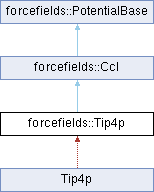
Inheritance diagram for forcefields::Tip4p:
Classes | |
| struct | Water |
| Pointers for one molecule of water. More... | |
Public Member Functions | |
| Tip4p () | |
| Tip4p (double cutoff, double switchingWidth) | |
| ~Tip4p () | |
| void | computeHH_O_ (const int nAtoms, const double R[], double F[], double &U, const double b[]) |
| Compute the forces and the energy. | |
| void | computeHH_O_ (const int nAtoms, const double R[], double F[], double &U, const double b[], const bool fixed[]) |
| Compute the forces and the energy (with fixed atom optimisation). | |
| Public Member Functions inherited from forcefields::Ccl | |
| Ccl () | |
| void | computeHH_O_ (const int nAtoms, const double R[], double F[], double &U, const double b[]) |
| Compute the forces and the energy. | |
| void | computeHH_O_ (const int nAtoms, const double R[], double F[], double &U, const double b[], const bool fixed[]) |
| Compute the forces and the energy (with fixed atom optimisation). | |
| char const * | getName () const |
| Name of the potential. | |
| Public Member Functions inherited from forcefields::PotentialBase | |
| PotentialBase () | |
| Non bond interaction cutoff. | |
| PotentialBase (double cutoff, double switchingWidth) | |
| virtual | ~PotentialBase () |
| double | getCutoff () const |
| void | setCutoff (double cutoff) |
| double | getSwitchingWidth () const |
| Width of the switching zone. | |
| void | setSwitchingWidth (double width) |
Static Public Member Functions | |
| static char const * | getName () |
| Name of the potential. | |
| static double | applyPeriodicity0 (double r, double const period) |
| Minimum image representation. | |
| static void | applyPeriodicity0 (double r[], double const periods[]) |
| Minimum image representation. | |
Private Member Functions | |
| template<int H, int O> | |
| void | computeTemplate (const int nMolecules, const double(*const rh1)[H *3], const double(*const rh2)[H *3], const double(*const ro)[O *3], double(*const fh1)[H *3], double(*const fh2)[H *3], double(*const fo)[O *3], double &energy, double const b[], bool const (*const xh1)[H]=0, bool const (*const xh2)[H]=0, bool const (*const xo)[O]=0) |
| Compute forces and energy. | |
| void | coulombWithCutoff (Water &w1, Water &w2, double &U) |
| Interactions between two molecules. | |
| void | coulombFull (Water &w1, Water &w2, double &U) |
| Interactions between two molecules. | |
| void | lennardJonesWithCutoff (Water &w1, Water &w2, double &U) |
| Interactions between two molecules. | |
Additional Inherited Members | |
| Protected Member Functions inherited from forcefields::Ccl | |
| Ccl (double cutoff, double switchingWidth) | |
| Constructor with cutoff for derived classes. | |
| void | intramolecular (double const rh1[], double const rh2[], double const ro[], double fh1[], double fh2[], double fo[], double &energy) |
| Interactions inside one molecules. | |
| void | initialiseRho (Vector3 const &v, Rho &r) |
| Initialise Rho. | |
| void | initialiseDtheta (Vector3 const &v1, Vector3 const &v2, Dtheta &dth, double const thetaEquilibrium) |
| Initialise Dtheta. | |
| void | intramolecular (Rho const &ro1, Rho const &ro2, Dtheta const &dth, double &energy, double fh1[], double fh2[], double fo[]) |
| Compute intramolecular energy and forces. | |
| Protected Member Functions inherited from forcefields::PotentialBase | |
| void | restrainAngle (double const r1[], double const r2[], double const r3[], double f1[], double f2[], double f3[], double &u, const double k, const double aeq) |
| Angular quadratic restraints. | |
| void | calculateCentre (double const r1[], double const r2[], double rc[]) |
| Calculate centre of two points. | |
| void | calculateCentre (double const r1[], double const r2[], double const r3[], double rc[]) |
| Calculate centre of three points. | |
| void | calculateWeightedCentre (double const w1, double const w2, double const w3, double const r1[], double const r2[], double const r3[], double rc[]) |
| Calculate barycentre. | |
| void | coulombWithCutoff (const double r1[], const double r2[], double f1[], double f2[], double &u, double const qq) |
| Coulomb interaction with single charge based cutoff. | |
| void | coulomb (const double r1[], const double r2[], double f1[], double f2[], double &u, double const qq) |
| Compute Coulomb interaction between two charges. | |
| void | coulomb (double distance, double &force, double &energy, double const qq) |
| Compute Coulomb interaction between two charges. | |
| void | spreadForce (double f1[], double f2[], double const fc[]) |
| Spread force on centre to other points. | |
| void | spreadForce (double f1[], double f2[], double f3[], double const fc[]) |
| Spread force on centre to other points. | |
| void | spreadWeightedForce (double const w1, double const w2, double const w3, double f1[], double f2[], double f3[], double const fc[]) |
| Spread force on barycentre to atoms. | |
| template<int N, class R, class F> | |
| void | addForces (ChargeGroup< N, R, F > const &g1, ChargeGroup< N, R, F > &g2) |
| Increment forces. | |
| template<int N, class R, class F> | |
| void | switching (ChargeGroup< N, R, F > &g1, ChargeGroup< N, R, F > &g2, double &energy, double cutoff, double switchingWidth) |
| void | computePt (int const nAtoms, double positions[], double forces[], double &energy, double const periods[], bool const fixed[]) |
| Potential for Platinum. | |
| void | restrainLength (const double R1[], const double R2[], double F1[], double F2[], double &u, const double k, const double r0) |
| Compute quadratic restraints between two atoms. | |
| void | lennardJones (double const distance, double &force, double &energy, double const epsilon, double const sigma) |
| Lennard-Jones 12-6 between two atoms. | |
| void | lennardJones (const double R1[], const double R2[], double F1[], double F2[], double &E, double const epsilon, double const sigma) |
| Lennard-Jones 12-6 between two atoms. | |
| void | lennardJonesWithCutoff (double const r1[], double const r2[], double f1[], double f2[], double &energy, double const epsilon, double const sigma) |
| Lennard Jones 12-6 Potential with cutoff. | |
| void | switching (double const distance, double &force, double &energy) |
| Smooth cutoff switch off. | |
| void | switching (double const r1[], double const r2[], double f1[], double f2[], double &energy) |
| Smooth cutoff switch off. | |
| double | applyPeriodicity1 (double r, int const axis) |
| Minimum image representation. | |
| void | applyPeriodicity1 (double r[]) |
| Minimum image representation. | |
| void | distance (const double x[], const double y[], double z[], double &z1, double &z2) |
| Distance vector, norm and norm square. | |
| void | distance (const double x[], const double y[], double z[], double &z1) |
| Distance. | |
| void | distance (const double x[], const double y[], double z[]) |
| Distance vector, norm. | |
| void | distance (const double x[], const double y[], double &z1) |
| Distance. | |
| void | distance (const double x[], const double y[], Vector3 &z) |
| Distance vector, norm and norm square. | |
| void | setPeriodicity (const double periods[]) |
| Set periodicity. | |
| double | unBreak1 (double const r, double const ref, int const axis) |
| Undo the separation of two atoms created by the periodic boundaries. | |
| void | unBreak1 (double r[], double const ref[]) |
| Undo the separation of two atoms created by the periodic boundaries. | |
| Static Protected Member Functions inherited from forcefields::PotentialBase | |
| static void | divide (double v[], double const divisor) |
| Divide vector. | |
| static double * | crossProduct (const double v[], const double w[], double e[]) |
| Cross product. | |
| static double | dotProduct (double const v[], double const w[]) |
| Dot product. | |
| static void | multiply (double v[], double const factor) |
| Multiply vector. | |
| static double | norm (double const v[]) |
| Norm of 3D vector. | |
| static void | normalise (double v[]) |
| Normalise 3D vector \( \frac{\mathbf v}{ |\mathbf v|} \). | |
| static double | isoscelesBase (double length, double angle) |
| Calculate the base of an isosceles triangle. | |
| static double | epsilon (double const A, double const B) |
| Conversion for Lennard-Jones. | |
| static double | sigma (double const A, double const B) |
| Conversion for Lennard-Jones. | |
| static double | smithKongEpsilon (double sigma1, double epsilon1, double sigma2, double epsilon2) |
| Smith and Kong combination rules. | |
| static double | smithKongSigma (double sigma1, double epsilon1, double sigma2, double epsilon2) |
| Smith and Kong combination rules. | |
| static double | unBreak0 (double const r, double const ref, double const period) |
| Undo the separation of two atoms created by the periodic boundaries. | |
| static void | unBreak0 (double r[], double const ref[], double const periods[]) |
| Undo the separation of two atoms created by the periodic boundaries. | |
| Protected Attributes inherited from forcefields::PotentialBase | |
| double | cutoff_ |
| double | periods_ [3] |
| double | switchingWidth_ |
| Static Protected Attributes inherited from forcefields::Ccl | |
| static double const | re_ = re_ |
| Distance OH at equilibrium. | |
| static double const | thetae_ = thetae_ |
| Distance OH at equilibrium. | |
| static const double | ONE_OVER_4_PI_EPSILON0 |
| static const double | EPSILON_PT = 0.68165797577788501 |
| Platinum Lennard-Jones. | |
| static const double | SIGMA_PT = 2.54 |
Detailed Description
TIP4P forcefield with fexible molecules and group based cutoff.
The function computing the forces and energy is compute(). Parameters for the forcefield were taken from Abascal et al.. The parameters are those of TIP4P (original version). TIP4P is a potential for constrained molecules of water. In this implementation quadratic restraints were added to bonds OH and HH inside molecules of water. So the potential can be used without constraints. The potential has a cutoff for long range interaction. The cutoff can be changed by setCutoff(). There is also and switching zone at the edge of the cutoff to cut off the interactions smoothly. The width of this switching zone is controlled by setSwitchingWidth().
The unit system for this potential is eV (electron volt), Angstrom, e (e charge).
References
A general purpose model for the condensed phases of water: TIP4P/2005, J.L.F. Abascal and C. Vega, J. Chem. Phys. (2005) vol. 123, p. 234505.
Definition at line 23 of file tip4p_ccl.hpp.
Constructor & Destructor Documentation
◆ Tip4p() [1/2]
| Tip4p::Tip4p | ( | ) |
Definition at line 66 of file tip4p_ccl.cpp.
67 : Ccl() {}
◆ Tip4p() [2/2]
| Tip4p::Tip4p | ( | double | cutoff, |
| double | switchingWidth ) |
Definition at line 69 of file tip4p_ccl.cpp.
70 : Ccl(cutoff, switchingWidth) {}
◆ ~Tip4p()
|
inline |
Definition at line 27 of file tip4p_ccl.hpp.
27{}
Member Function Documentation
◆ computeHH_O_() [1/2]
| void Tip4p::computeHH_O_ | ( | const int | nAtoms, |
| const double | R[], | ||
| double | F[], | ||
| double & | U, | ||
| const double | b[] ) |
Compute the forces and the energy.
The order of the atoms is very important. For this function the order is H1, H1, H2, H2, etc ... , O1, O2, etc ... The numbers are for the molecules. The suffix HH_O_ is to reminds the ordering of the atoms. It indicates the position of the atoms of the first molecule, while the underscore marks the locations of other atoms.
- Parameters
-
[in] nAtoms Number of Atoms. [in] R coordinates. [out] F Forces. [out] U Potential energy. [in] b Periodic boundaries.
- Warning
- Be careful with the order of the atoms.
Definition at line 84 of file tip4p_ccl.cpp.
85 {
86 computeHH_O_(nAtoms, R, F, U, b, 0);
87}
void computeHH_O_(const int nAtoms, const double R[], double F[], double &U, const double b[])
Compute the forces and the energy.
Definition tip4p_ccl.cpp:84
◆ computeHH_O_() [2/2]
| void Tip4p::computeHH_O_ | ( | const int | nAtoms, |
| const double | R[], | ||
| double | F[], | ||
| double & | U, | ||
| const double | b[], | ||
| const bool | fixed[] ) |
Compute the forces and the energy (with fixed atom optimisation).
In a simulation, some atoms may be fixed (not allowed to move). Computing the interaction between two fixed atoms is useless. When the potential knows which atoms are fixed, it can avoid these useless computations.
- Parameters
-
[in] nAtoms Number of Atoms. [in] R coordinates. [out] F Forces. [out] U Potential energy. [in] b Periodic boundaries. [in] fixed The length of the array must be equal to nAtoms in compute(). True when atom is fixed, false otherwise.
- See also
- Check compute() for the order of the atoms.
Definition at line 102 of file tip4p_ccl.cpp.
103 {
104 int const nMolecules = nAtoms / 3;
105 const double (*const rh1)[6] = reinterpret_cast<const double (*)[6]>(R);
106 const double (*const rh2)[6] = reinterpret_cast<const double (*)[6]>(&R[3]);
107 const double (*const ro)[3] =
108 reinterpret_cast<const double (*)[3]>(&R[nMolecules * 6]);
109 double (*const fh1)[6] = reinterpret_cast<double (*)[6]>(F);
110 double (*const fh2)[6] = reinterpret_cast<double (*)[6]>(&F[3]);
111 double (*const fo)[3] = reinterpret_cast<double (*)[3]>(&F[nMolecules * 6]);
112 bool const(*const xh1)[2] = reinterpret_cast<bool const(*)[2]>(fixed);
113 bool const(*const xh2)[2] = reinterpret_cast<bool const(*)[2]>(&fixed[1]);
114 bool const(*const xo)[1] =
115 reinterpret_cast<bool const(*)[1]>(&fixed[nMolecules * 2]);
116 computeTemplate(nMolecules, rh1, rh2, ro, fh1, fh2, fo, U, b, xh1, xh2, xo);
117}
void computeTemplate(const int nMolecules, const double(*const rh1)[H *3], const double(*const rh2)[H *3], const double(*const ro)[O *3], double(*const fh1)[H *3], double(*const fh2)[H *3], double(*const fo)[O *3], double &energy, double const b[], bool const (*const xh1)[H]=0, bool const (*const xh2)[H]=0, bool const (*const xo)[O]=0)
Compute forces and energy.
Definition tip4p_ccl.cpp:156
◆ computeTemplate()
template<int H, int O>
|
private |
Compute forces and energy.
The function calculates and returns the energy and forces applied on each atom. The function has preconditions with which the user must comply before calling this function. The periodic boundaries must set with (setPeriodicity()). The content of and arrays fh1 , fh2 , fo must be zero for all elements.
Arrays ending in h1 are for the hydrogen one of the molecules and those ending in h2 for hydrogen 2.
- Parameters
-
[in] nMolecules Number of molecules. [in] rh1, rh2, ro Positions of hydrogens and oxygens. [in,out] fh1, fh2, fo Forces on hydrogens and oxygens. [in,out] energy Potential energy. [in] b Periodic boundaries. [in] xh1, xh2, xo Tell which atoms are fixed and which are movable. This parameter are optional. When provided, interaction between fixed atoms are skipped. The three arrays xh1, xh2, xo must be provided for the optimisation to work.
- Warning
- Remember the preconditions.
Definition at line 156 of file tip4p_ccl.cpp.
162 {
163 for (int i = 0; i < nMolecules; ++i) {
164 for (int a = 0; a < 3; a++) {
165 fh1[i][a] = 0.0;
166 fh2[i][a] = 0.0;
167 fo[i][a] = 0.0;
168 };
169 };
170 energy = 0.0;
171 setPeriodicity(b);
172 for (int i = nMolecules - 1; i >= 0; --i) {
173 double rc1[3], rn1[3], fn1[3] = {0}; // rn position charge N, rc centre of
174 // charge for groupbased cutoff.
175 calculateWeightedCentre(wo_, wh_, wh_, ro[i], rh1[i], rh2[i], rn1);
176 calculateCentre(rn1, rh1[i], rh2[i], rc1);
177 Water w1 = {rh1[i], rh2[i], ro[i], rn1, rc1, fh1[i], fh2[i], fo[i], fn1};
178 intramolecular(rh1[i], rh2[i], ro[i], fh1[i], fh2[i], fo[i], energy);
179 for (int j = i - 1; j >= 0; --j) {
180 bool areFixed = false;
181 if (xh1 and xh2 and xo) {
182 areFixed = xh1[i][0] and xh2[i][0] and xo[i][0];
183 // check if all the atoms of molecule j are fixed.
184 areFixed &= xh1[j][0] and xh2[j][0] and xo[j][0];
185 };
186 // if both molecules are fixed skip force calculation
187 if (not areFixed) {
188 double rc2[3], rn2[3], fn2[3] = {0};
189 calculateWeightedCentre(wo_, wh_, wh_, ro[j], rh1[j], rh2[j], rn2);
190 calculateCentre(rn2, rh1[j], rh2[j], rc2);
191 Water w2 = {rh1[j], rh2[j], ro[j], rn2, rc2,
192 fh1[j], fh2[j], fo[j], fn2};
193 coulombWithCutoff(w1, w2, energy);
194 spreadWeightedForce(wo_, wh_, wh_, w2.fo_, w2.fh1_, w2.fh2_, w2.fn_);
195 lennardJonesWithCutoff(w1, w2, energy);
196 };
197 };
198 spreadWeightedForce(wo_, wh_, wh_, w1.fo_, w1.fh1_, w1.fh2_, w1.fn_);
199 };
200 assert(not std::isnan(energy) and not std::isinf(energy));
201}
void intramolecular(double const rh1[], double const rh2[], double const ro[], double fh1[], double fh2[], double fo[], double &energy)
Interactions inside one molecules.
Definition ccl.cpp:233
void calculateWeightedCentre(double const w1, double const w2, double const w3, double const r1[], double const r2[], double const r3[], double rc[])
Calculate barycentre.
Definition potential_base.cpp:208
void calculateCentre(double const r1[], double const r2[], double rc[])
Calculate centre of two points.
Definition potential_base.cpp:188
void spreadWeightedForce(double const w1, double const w2, double const w3, double f1[], double f2[], double f3[], double const fc[])
Spread force on barycentre to atoms.
Definition potential_base.cpp:312
void coulombWithCutoff(Water &w1, Water &w2, double &U)
Interactions between two molecules.
Definition tip4p_ccl.cpp:209
void lennardJonesWithCutoff(Water &w1, Water &w2, double &U)
Interactions between two molecules.
Definition tip4p_ccl.cpp:273
◆ coulombFull()
Interactions between two molecules.
Coulomb interaction between two molecules. Full interaction (i.e. no cutoff).
- Parameters
-
[in,out] w1 Molecule 1. [in,out] w2 Molecule 2. [in,out] U Add the potential energy to U.
- See also
- intermolecularFull() and intermolecularSwitching().
- Note
- The function add the force on charge N to Water::fn_ but does not spread it to Water::fh1_, etc ...
- See also
- spreadN().
Definition at line 251 of file tip4p_ccl.cpp.
251 {
252 // Coulomb interactions between hydrogens
253 coulomb(w1.rh1_, w2.rh1_, w1.fh1_, w2.fh1_, U, charge2_);
254 coulomb(w1.rh1_, w2.rh2_, w1.fh1_, w2.fh2_, U, charge2_);
255 coulomb(w1.rh2_, w2.rh1_, w1.fh2_, w2.fh1_, U, charge2_);
256 coulomb(w1.rh2_, w2.rh2_, w1.fh2_, w2.fh2_, U, charge2_);
257 // interactions between H and N.
258 coulomb(w1.rn_, w2.rh1_, w1.fn_, w2.fh1_, U, -2.0 * charge2_);
259 coulomb(w1.rn_, w2.rh2_, w1.fn_, w2.fh2_, U, -2.0 * charge2_);
260 coulomb(w1.rh1_, w2.rn_, w1.fh1_, w2.fn_, U, -2.0 * charge2_);
261 coulomb(w1.rh2_, w2.rn_, w1.fh2_, w2.fn_, U, -2.0 * charge2_);
262 // interactions between N1, N2
263 coulomb(w1.rn_, w2.rn_, w1.fn_, w2.fn_, U, 4.0 * charge2_);
264}
void coulomb(const double r1[], const double r2[], double f1[], double f2[], double &u, double const qq)
Compute Coulomb interaction between two charges.
Definition potential_base.cpp:256
◆ coulombWithCutoff()
Interactions between two molecules.
Coulomb interaction between two molecules of water with molecules-based cutoff
- Parameters
-
[in,out] w1 Molecule 1. [in,out] w2 Molecule 2. [in,out] U Add the potential energy to U.
Definition at line 209 of file tip4p_ccl.cpp.
209 {
210 double z[3], z1, z2;
211 distance(w1.rc_, w2.rc_, z, z1, z2);
213 coulombFull(w1, w2, U);
215 double f1[3][3] = {{0}}, f2[3][3] = {{0}};
216 // f1[0], f1[1], 0, f1[2] are respectively, H1, H2, O, N. There is no charge
217 // on O.
218 Water v1 = {w1.rh1_, w1.rh2_, w1.ro_, w1.rn_, w1.rc_,
219 f1[0], f1[1], 0, f1[2]};
220 Water v2 = {w2.rh1_, w2.rh2_, w2.ro_, w2.rn_, w2.rc_,
221 f2[0], f2[1], 0, f2[2]};
222 double energy = 0.0;
223 coulombFull(v1, v2, energy);
224 ChargeGroup<3> g1 = {v1.rc_, 0, f1};
225 ChargeGroup<3> g2 = {v2.rc_, 0, f2};
226 // Calculate the weakened forces and energy.
228 // add weakened force and energy to those of other interactions.
229 U += energy;
230 for (int i = 0; i < 3; ++i) {
231 w1.fh1_[i] += v1.fh1_[i];
232 w1.fh2_[i] += v1.fh2_[i];
233 w1.fn_[i] += v1.fn_[i];
234 w2.fh1_[i] += v2.fh1_[i];
235 w2.fh2_[i] += v2.fh2_[i];
236 w2.fn_[i] += v2.fn_[i];
237 };
238 }
239}
void switching(ChargeGroup< N, R, F > &g1, ChargeGroup< N, R, F > &g2, double &energy, double cutoff, double switchingWidth)
Definition potential_base.hpp:163
void distance(const double x[], const double y[], double z[], double &z1, double &z2)
Distance vector, norm and norm square.
Definition potential_base.cpp:555
void coulombFull(Water &w1, Water &w2, double &U)
Interactions between two molecules.
Definition tip4p_ccl.cpp:251
◆ getName()
|
static |
◆ lennardJonesWithCutoff()
Interactions between two molecules.
Lennard Jones between oxygen only with cutoff
- Parameters
-
[in,out] w1 Molecule of water 1. [in,out] w2 Molecule of water 2. [in,out] U Add the potential energy to U.
- See also
- intermolecularFull() and intermolecularSwitching().
Definition at line 273 of file tip4p_ccl.cpp.
273 {
274 double z[3], z1;
275 distance(w1.ro_, w2.ro_, z, z1);
277 lennardJones(w1.ro_, w2.ro_, w1.fo_, w2.fo_, U, epsilon_, sigma_);
279 double f1[3] = {0}, f2[3] = {0};
280 double energy = 0.0;
281 lennardJones(w1.ro_, w2.ro_, f1, f2, energy, epsilon_, sigma_);
282 switching(w1.ro_, w2.ro_, f1, f2, energy);
283 U += energy;
284 for (int i = 0; i < 3; i++) {
285 w1.fo_[i] += f1[i];
286 w2.fo_[i] += f2[i];
287 };
288 };
289}
void lennardJones(double const distance, double &force, double &energy, double const epsilon, double const sigma)
Lennard-Jones 12-6 between two atoms.
Definition potential_base.cpp:347
The documentation for this class was generated from the following files:
- /home/runner/work/eOn/eOn/include/eon/potentials/Water/tip4p_ccl.hpp
- /home/runner/work/eOn/eOn/client/potentials/Water/tip4p_ccl.cpp
- Generated by
 1.17.0