Loading...
Searching...
No Matches
forcefields::ZhuPhilpott< P > Class Template Reference
Forcefield for water and platinum interactions. More...
#include <zhu_philpott.hpp>
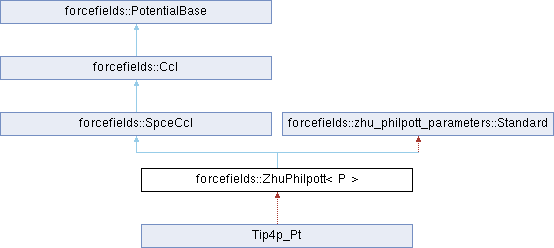
Inheritance diagram for forcefields::ZhuPhilpott< P >:
Public Member Functions | |
| ZhuPhilpott () | |
| ZhuPhilpott (double cutoff, double switchingWidth) | |
| ZhuPhilpott (ZhuPhilpott const &) | |
| void | operator= (ZhuPhilpott const &) |
| ~ZhuPhilpott () | |
| void | computeHH_O_Pt_ (const int nWater, const int nPt, const double r[], double f[], double &energy, double const b[], bool const fixed[]) |
| Compute water-platinum forcefield. | |
| void | computeHH_O_ (const int nWater, const double r[], double f[], double &energy, double const b[], bool const fixed[]) |
| Compute water-platinum interactions, call with water's positions only. | |
| int | nPlatinum () const |
| Number of platinum atoms. | |
| void | setPlatinum (int nPlatinum, double const positions[]) |
| Initialises the positions of the atoms of platinum. | |
| template<int H, int O, int H3, int O3> | |
| void | computeTemplate (const int nWater, const double(*const rh1)[H3], const double(*const rh2)[H3], const double(*const ro)[O3], double(*const fh1)[H3], double(*const fh2)[H3], double(*const fo)[O3], const int nPt, const double rPt[][3], double fPt[][3], double &energy, double const b[], bool const (*const xh1)[H], bool const (*const xh2)[H], bool const (*const xo)[O], bool const xPt[]) |
| Public Member Functions inherited from forcefields::SpceCcl | |
| SpceCcl () | |
| SpceCcl (double cutoff, double switchingWidth) | |
| void | computeHH_O_ (const int nAtoms, const double R[], double F[], double &U, const double b[]) |
| Compute the forces and the energy. | |
| void | computeHH_O_ (const int nAtoms, const double R[], double F[], double &U, const double b[], const bool fixed[]) |
| Compute the forces and the energy (with fixed atom optimisation). | |
| char const * | getName () const |
| Name of the potential. | |
| Public Member Functions inherited from forcefields::Ccl | |
| Ccl () | |
| void | computeHH_O_ (const int nAtoms, const double R[], double F[], double &U, const double b[]) |
| Compute the forces and the energy. | |
| void | computeHH_O_ (const int nAtoms, const double R[], double F[], double &U, const double b[], const bool fixed[]) |
| Compute the forces and the energy (with fixed atom optimisation). | |
| char const * | getName () const |
| Name of the potential. | |
| Public Member Functions inherited from forcefields::PotentialBase | |
| PotentialBase () | |
| Non bond interaction cutoff. | |
| PotentialBase (double cutoff, double switchingWidth) | |
| virtual | ~PotentialBase () |
| double | getCutoff () const |
| void | setCutoff (double cutoff) |
| double | getSwitchingWidth () const |
| Width of the switching zone. | |
| void | setSwitchingWidth (double width) |
Static Public Member Functions | |
| static char const * | getName () |
| Name of the potential. | |
| static double | applyPeriodicity0 (double r, double const period) |
| Minimum image representation. | |
| static void | applyPeriodicity0 (double r[], double const periods[]) |
| Minimum image representation. | |
Private Member Functions | |
| template<int H, int O, int H3, int O3> | |
| void | computeTemplate (const int nWater, const double(*const rh1)[H3], const double(*const rh2)[H3], const double(*const ro)[O3], double(*const fh1)[H3], double(*const fh2)[H3], double(*const fo)[O3], const int nPt, const double rPt[][3], double fPt[][3], double &energy, double const b[], bool const (*const xh1)[H]=0, bool const (*const xh2)[H]=0, bool const (*const xo)[O]=0, bool const *xPt=0) |
| void | interactWithCorePt (Water &water, int const nPt, double const rPt[][3], double fPt[][3], double &energy) |
| Interaction of one molecule of water with the whole platinum. | |
| void | interactionPtO (double const R1[], double const R2[], double F1[], double F2[], double &energy) |
| void | interactionPtH (double const R1[], double const R2[], double F1[], double F2[], double &energy) |
| void | anisotropic (const double distance[], double force[], double &energy, double const epsilon, double const sigma, double const alpha) |
| Anisotropic interaction between water and platinum. | |
| void | isotropic10 (double const distance, double &force, double &energy, double const epsilon, double const sigma, double const C10) |
| Isotropic interaction between water and platinum. | |
| void | interactWithImage (Water &w1, Water &w2, double &U) |
| Interactions of a molecule with an image. | |
| void | coulombWithCutoff (Water &w1, Water &w2, double &u, double const relativePermittivity) |
| Coulomb interaction between two molecules within the swithcing zone. | |
| void | coulombFull (Water &w1, Water &w2, double &U, double const relativePermittivity) |
| Coulomb interaction between two molecules with cutoff. | |
Private Attributes | |
| int | nPlatinum_ {0} |
| std::vector< double > | positions_ |
| std::vector< double > | forces_ |
Additional Inherited Members | |
| Protected Member Functions inherited from forcefields::SpceCcl | |
| void | intramolecular (Water &water, double &U) |
| Interactions within a molecules. | |
| void | lennardJonesWithCutoff (Water &w1, Water &w2, double &U) |
| Interactions between two molecules. | |
| void | coulombWithCutoff (Water &w1, Water &w2, double &U) |
| Interactions between two molecules. | |
| void | coulombFull (Water &w1, Water &w2, double &U) |
| Interactions between two molecules. | |
| Protected Member Functions inherited from forcefields::Ccl | |
| Ccl (double cutoff, double switchingWidth) | |
| Constructor with cutoff for derived classes. | |
| void | intramolecular (double const rh1[], double const rh2[], double const ro[], double fh1[], double fh2[], double fo[], double &energy) |
| Interactions inside one molecules. | |
| void | initialiseRho (Vector3 const &v, Rho &r) |
| Initialise Rho. | |
| void | initialiseDtheta (Vector3 const &v1, Vector3 const &v2, Dtheta &dth, double const thetaEquilibrium) |
| Initialise Dtheta. | |
| void | intramolecular (Rho const &ro1, Rho const &ro2, Dtheta const &dth, double &energy, double fh1[], double fh2[], double fo[]) |
| Compute intramolecular energy and forces. | |
| Protected Member Functions inherited from forcefields::PotentialBase | |
| void | restrainAngle (double const r1[], double const r2[], double const r3[], double f1[], double f2[], double f3[], double &u, const double k, const double aeq) |
| Angular quadratic restraints. | |
| void | calculateCentre (double const r1[], double const r2[], double rc[]) |
| Calculate centre of two points. | |
| void | calculateCentre (double const r1[], double const r2[], double const r3[], double rc[]) |
| Calculate centre of three points. | |
| void | calculateWeightedCentre (double const w1, double const w2, double const w3, double const r1[], double const r2[], double const r3[], double rc[]) |
| Calculate barycentre. | |
| void | coulombWithCutoff (const double r1[], const double r2[], double f1[], double f2[], double &u, double const qq) |
| Coulomb interaction with single charge based cutoff. | |
| void | coulomb (const double r1[], const double r2[], double f1[], double f2[], double &u, double const qq) |
| Compute Coulomb interaction between two charges. | |
| void | coulomb (double distance, double &force, double &energy, double const qq) |
| Compute Coulomb interaction between two charges. | |
| void | spreadForce (double f1[], double f2[], double const fc[]) |
| Spread force on centre to other points. | |
| void | spreadForce (double f1[], double f2[], double f3[], double const fc[]) |
| Spread force on centre to other points. | |
| void | spreadWeightedForce (double const w1, double const w2, double const w3, double f1[], double f2[], double f3[], double const fc[]) |
| Spread force on barycentre to atoms. | |
| template<int N, class R, class F> | |
| void | addForces (ChargeGroup< N, R, F > const &g1, ChargeGroup< N, R, F > &g2) |
| Increment forces. | |
| template<int N, class R, class F> | |
| void | switching (ChargeGroup< N, R, F > &g1, ChargeGroup< N, R, F > &g2, double &energy, double cutoff, double switchingWidth) |
| void | computePt (int const nAtoms, double positions[], double forces[], double &energy, double const periods[], bool const fixed[]) |
| Potential for Platinum. | |
| void | restrainLength (const double R1[], const double R2[], double F1[], double F2[], double &u, const double k, const double r0) |
| Compute quadratic restraints between two atoms. | |
| void | lennardJones (double const distance, double &force, double &energy, double const epsilon, double const sigma) |
| Lennard-Jones 12-6 between two atoms. | |
| void | lennardJones (const double R1[], const double R2[], double F1[], double F2[], double &E, double const epsilon, double const sigma) |
| Lennard-Jones 12-6 between two atoms. | |
| void | lennardJonesWithCutoff (double const r1[], double const r2[], double f1[], double f2[], double &energy, double const epsilon, double const sigma) |
| Lennard Jones 12-6 Potential with cutoff. | |
| void | switching (double const distance, double &force, double &energy) |
| Smooth cutoff switch off. | |
| void | switching (double const r1[], double const r2[], double f1[], double f2[], double &energy) |
| Smooth cutoff switch off. | |
| double | applyPeriodicity1 (double r, int const axis) |
| Minimum image representation. | |
| void | applyPeriodicity1 (double r[]) |
| Minimum image representation. | |
| void | distance (const double x[], const double y[], double z[], double &z1, double &z2) |
| Distance vector, norm and norm square. | |
| void | distance (const double x[], const double y[], double z[], double &z1) |
| Distance. | |
| void | distance (const double x[], const double y[], double z[]) |
| Distance vector, norm. | |
| void | distance (const double x[], const double y[], double &z1) |
| Distance. | |
| void | distance (const double x[], const double y[], Vector3 &z) |
| Distance vector, norm and norm square. | |
| void | setPeriodicity (const double periods[]) |
| Set periodicity. | |
| double | unBreak1 (double const r, double const ref, int const axis) |
| Undo the separation of two atoms created by the periodic boundaries. | |
| void | unBreak1 (double r[], double const ref[]) |
| Undo the separation of two atoms created by the periodic boundaries. | |
| Static Protected Member Functions inherited from forcefields::PotentialBase | |
| static void | divide (double v[], double const divisor) |
| Divide vector. | |
| static double * | crossProduct (const double v[], const double w[], double e[]) |
| Cross product. | |
| static double | dotProduct (double const v[], double const w[]) |
| Dot product. | |
| static void | multiply (double v[], double const factor) |
| Multiply vector. | |
| static double | norm (double const v[]) |
| Norm of 3D vector. | |
| static void | normalise (double v[]) |
| Normalise 3D vector \( \frac{\mathbf v}{ |\mathbf v|} \). | |
| static double | isoscelesBase (double length, double angle) |
| Calculate the base of an isosceles triangle. | |
| static double | epsilon (double const A, double const B) |
| Conversion for Lennard-Jones. | |
| static double | sigma (double const A, double const B) |
| Conversion for Lennard-Jones. | |
| static double | smithKongEpsilon (double sigma1, double epsilon1, double sigma2, double epsilon2) |
| Smith and Kong combination rules. | |
| static double | smithKongSigma (double sigma1, double epsilon1, double sigma2, double epsilon2) |
| Smith and Kong combination rules. | |
| static double | unBreak0 (double const r, double const ref, double const period) |
| Undo the separation of two atoms created by the periodic boundaries. | |
| static void | unBreak0 (double r[], double const ref[], double const periods[]) |
| Undo the separation of two atoms created by the periodic boundaries. | |
| Protected Attributes inherited from forcefields::PotentialBase | |
| double | cutoff_ |
| double | periods_ [3] |
| double | switchingWidth_ |
| Static Protected Attributes inherited from forcefields::SpceCcl | |
| static const double | roh_ = 1.0 |
| Distance OH. | |
| static const double | theta_ = 1.91063 |
| Angle HOH. | |
| static const double | rhh_ = 1.63299 |
| Distance HH. | |
| static const double | charge_ = 0.4238 |
| Charge on one hydrogen. | |
| static const double | charge2_ = 0.179606 |
| Square of # charge_. | |
| static const double | A_ = 27291.6 |
| Lennard-Jones. | |
| static const double | B_ = 27.1223 |
| Lennard-Jones. | |
| static const double | sigma_ = 3.16556 |
| Lennard-Jones. See PotentialBase::lennardJones() for definition. | |
| static const double | epsilon_ = 0.00673853 |
| Lennard-Jones. See PotentialBase::lennardJones() for definition. | |
| static double const | polarisationEnergy_ = 0.0541015 |
| Polarisation correction. | |
| Static Protected Attributes inherited from forcefields::Ccl | |
| static double const | re_ = re_ |
| Distance OH at equilibrium. | |
| static double const | thetae_ = thetae_ |
| Distance OH at equilibrium. | |
| static const double | ONE_OVER_4_PI_EPSILON0 |
| static const double | EPSILON_PT = 0.68165797577788501 |
| Platinum Lennard-Jones. | |
| static const double | SIGMA_PT = 2.54 |
| Static Private Attributes inherited from forcefields::zhu_philpott_parameters::Standard | |
| static double const | sigmaO_ = 2.86 |
| static double const | epsilonO_ = 0.0023734176137013181 |
| static double const | sigmaH_ = 2.56 |
| static double const | epsilonH_ = 0.00087578073518673099 |
| static double const | C10_O_ = 1.28 |
| static double const | C10_H_ = 1.2 |
| static double const | alpha_ = 0.8 |
| static double const | sigmaHPt_ = 2.730249677569295 |
| static double const | sigmaOPt_ = 2.7735458150747108 |
| static double const | epsilonHPt_ = 0.016217645873043762 |
| static double const | epsilonOPt_ = 0.03387330127291549 |
Detailed Description
template<class P = zhu_philpott_parameters::Standard>
class forcefields::ZhuPhilpott< P >
class forcefields::ZhuPhilpott< P >
Forcefield for water and platinum interactions.
This forcefield is the A2 water-platinum potential invented by Zhuand Philpott. It includes the SPC/E+CCL potential for interaction between the molecules of water. The SPC/E is a potential for constrained water. This implementation includes restraints so it may be used without constraint (see class SpceCcl).
The potential uses Kong's rules to combine the Lennard-Jones parameters of platinum with oxygen and hydrogen. A review of combination rules including Kong's rule can be find on the web.
The system of unit used by the class is (eV, Angstrom, fs, e).
References
Interaction of water with metal surfaces, S.-B. Zhu and M.R. Philpott J. Chem. Phys. (1994) vol. 100, No 9, p. 6961.
A Molecular Dynamics Simulation of Water Droplet in Contact with a Platinum Surface, T. Kimura and S. Maruyama, University of Tokyo.
Unlike Lennard-Jones Parameters for Vapor-Liquid Equilibria, Thorsten Schnabel, Jadran Vrabec , Hans Hasse, Institut fur Technische Thermodynamik und Thermische Verfahrenstechnik, Universitat Stuttgart, D-70550 Stuttgart, Germany, http://www.itt.uni-stuttgart.de/~schnabel/CR.pdf.
Definition at line 25 of file zhu_philpott.hpp.
Constructor & Destructor Documentation
◆ ZhuPhilpott() [1/3]
template<class P>
| forcefields::ZhuPhilpott< P >::ZhuPhilpott | ( | ) |
Definition at line 66 of file zhu_philpott.cpp.
◆ ZhuPhilpott() [2/3]
template<class P>
| forcefields::ZhuPhilpott< P >::ZhuPhilpott | ( | double | cutoff, |
| double | switchingWidth ) |
Definition at line 74 of file zhu_philpott.cpp.
76 nPlatinum_ = 0;
77 positions_.clear();
78 forces_.clear();
79}
Forcefield for water and platinum interactions.
Definition zhu_philpott.hpp:25
◆ ZhuPhilpott() [3/3]
template<class P>
| forcefields::ZhuPhilpott< P >::ZhuPhilpott | ( | ZhuPhilpott< P > const & | zhuPhilpott | ) |
Definition at line 81 of file zhu_philpott.cpp.
◆ ~ZhuPhilpott()
template<class P>
|
default |
Member Function Documentation
◆ anisotropic()
template<class P>
|
private |
Anisotropic interaction between water and platinum.
The isotropic iteraction between a atom Pt and an atom O or H of a molecule of water has the function form:
\[ E=4\epsilon\left[ \left(\frac{\sigma^2}{\alpha^2\rho^2+z^2}\right)^6-\left(\frac{\sigma^2}{\rho^2/\alpha^2+z^2}\right)^3 \right] \]
- Parameters
-
[in] distance Vector distance between to atom. [in,out] force Vector force created by the interaction between the two atoms. [in,out] energy Energy created by the interaction. [in] epsilon See equation. [in] sigma See equation. [in] alpha See equation.
Definition at line 388 of file zhu_philpott.cpp.
390 {
392 // WARNING: F1 and F2 are incremented.
415}
void distance(const double x[], const double y[], double z[], double &z1, double &z2)
Distance vector, norm and norm square.
Definition potential_base.cpp:555
static double epsilon(double const A, double const B)
Conversion for Lennard-Jones.
Definition potential_base.cpp:333
static double sigma(double const A, double const B)
Conversion for Lennard-Jones.
Definition potential_base.cpp:423
◆ computeHH_O_()
template<class P>
| void forcefields::ZhuPhilpott< P >::computeHH_O_ | ( | const int | nWater, |
| const double | r[], | ||
| double | f[], | ||
| double & | energy, | ||
| double const | b[], | ||
| bool const | fixed[] ) |
Compute water-platinum interactions, call with water's positions only.
This function is called with the coordinates of the atoms of water only. The positions of the platinum atoms must have been previously provided through function setPlatinum().
- Parameters
-
[in] nWater Number of molecules of water. [in] r Positions of atoms in water. [out] f Forces on the atoms in water. [out] energy Potential energy. [in] b Periodic boundaries. Length: 3 [in] fixed True for fixed atoms, false otherwise. The length of arrays r and f is \( 9\times nWater \). The length of array fixed is \( 3 \times nWater \).
- Note
- The function does not return the forces on platinum atoms as they as assumed to be fixed.
- See also
- setPlatinum() and computeHH_O_Pt_().
Definition at line 161 of file zhu_philpott.cpp.
163 {
170
175
183 } else {
189 };
190}
void computeTemplate(const int nWater, const double(*const rh1)[H3], const double(*const rh2)[H3], const double(*const ro)[O3], double(*const fh1)[H3], double(*const fh2)[H3], double(*const fo)[O3], const int nPt, const double rPt[][3], double fPt[][3], double &energy, double const b[], bool const (*const xh1)[H]=0, bool const (*const xh2)[H]=0, bool const (*const xo)[O]=0, bool const *xPt=0)
◆ computeHH_O_Pt_()
template<class P>
| void forcefields::ZhuPhilpott< P >::computeHH_O_Pt_ | ( | const int | nWater, |
| const int | nPt, | ||
| const double | r[], | ||
| double | f[], | ||
| double & | energy, | ||
| double const | b[], | ||
| bool const | fixed[] ) |
Compute water-platinum forcefield.
- Parameters
-
[in] nWater Number of molecules of water. [in] nPt Number of platinum atoms. [in] r Positions of the atoms. [out] f Forces on the atoms. [out] energy Potential energy. [in] b Periodic boundaries. Length: 3 [in] fixed True for fixed atoms, false otherwise. The order of the atoms is all hydrogens (hydrogens belonging to the same molecule are next to each others), all oxygen, all platinum. The length of arrays r and f is \( 3\times(3 \times nWater+nPt) \). The length of array fixed is \( 3 \times nWater+nPt \). When fixed is provided the interaction between two fixed atoms may be skipped to speed up the calculation. The parameter is optional.
- Warning
- The conductivity is simulated by interaction a mirror images of charges. The mirror surface is set at z=0, which should correspond to the location of the highest layer of platinum atoms.
Definition at line 111 of file zhu_philpott.cpp.
114 {
121
126
135 } else {
141 };
142}
◆ computeTemplate() [1/2]
template<class P = zhu_philpott_parameters::Standard>
template<int H, int O, int H3, int O3>
| void forcefields::ZhuPhilpott< P >::computeTemplate | ( | const int | nWater, |
| const double(*) | rh1[H3], | ||
| const double(*) | rh2[H3], | ||
| const double(*) | ro[O3], | ||
| double(*) | fh1[H3], | ||
| double(*) | fh2[H3], | ||
| double(*) | fo[O3], | ||
| const int | nPt, | ||
| const double | rPt[][3], | ||
| double | fPt[][3], | ||
| double & | energy, | ||
| double const | b[], | ||
| bool const (*) | xh1[H], | ||
| bool const (*) | xh2[H], | ||
| bool const (*) | xo[O], | ||
| bool const | xPt[] ) |
Definition at line 215 of file zhu_philpott.cpp.
221 {
227 };
228 };
232 };
233 energy = 0.0;
241 DEBUG_LEVEL_RETURN(0)
242 // Two next lines for interaction with platinum
246 DEBUG_LEVEL_RETURN(1)
248 DEBUG_LEVEL_RETURN(2)
254 // check if all the atoms of molecule j are fixed.
256 };
257 // if both molecules are fixed skip force calculation
263 DEBUG_LEVEL_RETURN(3)
265 DEBUG_LEVEL_RETURN(4)
266 // Two next lines for interaction with platinum
267 // called Vw-cond in Zhu and Philpott
270 DEBUG_LEVEL_RETURN(5)
271 };
272 };
273#ifndef NDEBUG
278 };
279#endif
280 };
282}
void calculateCentre(double const r1[], double const r2[], double rc[])
Calculate centre of two points.
Definition potential_base.cpp:188
void intramolecular(Water &water, double &U)
Interactions within a molecules.
Definition spce_ccl.cpp:159
void lennardJonesWithCutoff(Water &w1, Water &w2, double &U)
Interactions between two molecules.
Definition spce_ccl.cpp:86
void interactWithImage(Water &w1, Water &w2, double &U)
Interactions of a molecule with an image.
Definition zhu_philpott.cpp:449
void coulombWithCutoff(Water &w1, Water &w2, double &u, double const relativePermittivity)
Coulomb interaction between two molecules within the swithcing zone.
Definition zhu_philpott.cpp:496
void interactWithCorePt(Water &water, int const nPt, double const rPt[][3], double fPt[][3], double &energy)
Interaction of one molecule of water with the whole platinum.
Definition zhu_philpott.cpp:292
◆ computeTemplate() [2/2]
template<class P = zhu_philpott_parameters::Standard>
template<int H, int O, int H3, int O3>
|
private |
◆ coulombFull()
template<class P>
|
private |
Coulomb interaction between two molecules with cutoff.
Coulomb interaction between two molecules of water.
- Parameters
-
[in,out] w1, w2 Water molecules. [in,out] U Add the potential energy to U. [in] relativePermittivity
- See also
- getCutOff() and getSwitchingWidth().
Definition at line 525 of file zhu_philpott.cpp.
526 {
527 // q^2/relativePermittivity;
529 // Coulomb interactions between hydrogens
534 // interactions between H and O.
539 // interactions between O1, O2
541}
void coulomb(const double r1[], const double r2[], double f1[], double f2[], double &u, double const qq)
Compute Coulomb interaction between two charges.
Definition potential_base.cpp:256
◆ coulombWithCutoff()
template<class P>
|
private |
Coulomb interaction between two molecules within the swithcing zone.
The precondition for using the function is that the distance between w1 and w2 defined as \( |\mathbf r_{n1}-\mathbf r_{n2}| \) verifies the equation:
\[ C_{utoff}-S_{witchingWidth} < |\mathbf r_{n1}-\mathbf r_{n2}| < C_{utoff} \]
- Parameters
-
[in,out] w1 Molecule 1. [in,out] w2 Molecule 2. [in,out] U Add the potential energy to U. [in] relativePermittivity Relative permittivity.
- See also
- getCutOff() and getSwitchingWidth().
Definition at line 496 of file zhu_philpott.cpp.
497 {
514 };
515}
void switching(ChargeGroup< N, R, F > &g1, ChargeGroup< N, R, F > &g2, double &energy, double cutoff, double switchingWidth)
Definition potential_base.hpp:163
void addForces(ChargeGroup< N, R, F > const &g1, ChargeGroup< N, R, F > &g2)
Increment forces.
Definition potential_base.hpp:157
void coulombFull(Water &w1, Water &w2, double &U, double const relativePermittivity)
Coulomb interaction between two molecules with cutoff.
Definition zhu_philpott.cpp:525
◆ getName()
template<class P>
|
static |
Name of the potential.
Definition at line 209 of file zhu_philpott.cpp.
209 {
210 return "ZhuPhilpott";
211}
◆ interactionPtH()
template<class P>
|
private |
Definition at line 359 of file zhu_philpott.cpp.
360 {
368 };
369}
void anisotropic(const double distance[], double force[], double &energy, double const epsilon, double const sigma, double const alpha)
Anisotropic interaction between water and platinum.
Definition zhu_philpott.cpp:388
void isotropic10(double const distance, double &force, double &energy, double const epsilon, double const sigma, double const C10)
Isotropic interaction between water and platinum.
Definition zhu_philpott.cpp:430
◆ interactionPtO()
template<class P>
|
private |
Definition at line 346 of file zhu_philpott.cpp.
347 {
355 };
356}
◆ interactWithCorePt()
template<class P>
|
private |
Interaction of one molecule of water with the whole platinum.
- Parameters
-
[in,out] water Molecule of water. The forces are incremented. [in] nPt Number of Platinum atom. [in] rPt Positions of the platinum. [in,out] fPt Forces on the platinum. The forces are incremented [in,out] energy Add the energy.
Definition at line 292 of file zhu_philpott.cpp.
294 {
297 // Pt - O
310 };
311 };
312 // Pt - H1
325 };
326 };
327 // Pt - H2
340 };
341 };
342 };
343}
void interactionPtH(double const R1[], double const R2[], double F1[], double F2[], double &energy)
Definition zhu_philpott.cpp:359
void interactionPtO(double const R1[], double const R2[], double F1[], double F2[], double &energy)
Definition zhu_philpott.cpp:346
◆ interactWithImage()
template<class P>
|
private |
Interactions of a molecule with an image.
Coulomb interaction between w1 and the image of w2. Includes cutoff.
- Parameters
-
[in,out] w1 Molecule 1. [in,out] w2 Molecule 2. [in,out] U Add the potential energy to U.
- Note
- Does not include the interaction of w2 with the image of w1. For this you must explicitely call interactWithImage(w2, w1, U).
Definition at line 449 of file zhu_philpott.cpp.
449 {
450 // f is used to store the force on the atoms' images. These forces have no use
451 // and are at the end discarded. we use the same vector to store of the forces
452 // even when they are on different atoms' images.
459 };
460 // mirror about plane at z=0.
466 // -2 is given as the relative permittivity. This value is not the
467 // permittivity of the metal which is infinite in the case of a perfect metal.
468 // It is the value (1+epsilon_r)/(1-epsilon_r) which is equal to -1 for a
469 // perfect metal. This value is the 'effective' permittivity for the
470 // interaction of a charge with a mirror image.
476 };
477 // mirror about plane
481}
◆ isotropic10()
template<class P>
|
private |
Isotropic interaction between water and platinum.
The isotropic iteraction between a atom Pt and an atom O or H of a molecule of water has the functional form:
\[ E=-4\epsilon\ C_{10}\left(\frac{\sigma}{r}\right)^{10} \]
- Parameters
-
[in] distance Distance between two atoms. [in,out] force Force create by the interaction between the two atoms. [in,out] energy Energy created by the interaction. [in] epsilon See equation. [in] sigma See equation. [in] C10 See equation.
Definition at line 430 of file zhu_philpott.cpp.
◆ nPlatinum()
template<class P>
| int forcefields::ZhuPhilpott< P >::nPlatinum | ( | ) | const |
◆ operator=()
template<class P>
| void forcefields::ZhuPhilpott< P >::operator= | ( | ZhuPhilpott< P > const & | zhuPhilpott | ) |
Definition at line 86 of file zhu_philpott.cpp.
86 {
88}
void setPlatinum(int nPlatinum, double const positions[])
Initialises the positions of the atoms of platinum.
Definition zhu_philpott.cpp:200
◆ setPlatinum()
template<class P>
| void forcefields::ZhuPhilpott< P >::setPlatinum | ( | int | nPlatinum, |
| double const | positions[] ) |
Initialises the positions of the atoms of platinum.
Use before calling computeHH_O_().
Definition at line 200 of file zhu_philpott.cpp.
Member Data Documentation
◆ forces_
template<class P = zhu_philpott_parameters::Standard>
|
private |
Definition at line 70 of file zhu_philpott.hpp.
◆ nPlatinum_
template<class P = zhu_philpott_parameters::Standard>
|
private |
Definition at line 68 of file zhu_philpott.hpp.
68{0};
◆ positions_
template<class P = zhu_philpott_parameters::Standard>
|
private |
Definition at line 69 of file zhu_philpott.hpp.
The documentation for this class was generated from the following files:
- /home/runner/work/eOn/eOn/include/eon/potentials/Water_Pt/zhu_philpott.hpp
- /home/runner/work/eOn/eOn/client/potentials/Water_Pt/zhu_philpott.cpp
- Generated by
 1.17.0